

Signal-based selling uses a specific, observable change as a reason to research or contact an account. It adds timing and context to your ideal customer profile. It does not turn every company announcement, website visit or job change into proof of purchase intent.
The useful part is the decision process. A team captures an event and verifies the evidence. It then tests whether the event matters to the offer, chooses an action and records the result. The signal starts the investigation; it does not finish it.
If you need a library of possible triggers first, see our guide to B2B buying signals. This article focuses on what happens after a possible signal appears.
A practical signal-based selling workflow
Use this sequence:
Observe the event. Record exactly what happened without adding an interpretation.
Verify the evidence. Find the original source, publication date and account or person it refers to.
Test relevance. State why the event could affect the problem your offer solves.
Identify what is missing. List the evidence you would need before the hypothesis is strong enough to use.
Choose one route. Contact, research further or reject.
Act with context. If contact is justified, use one supported fact and ask a relevant question.
Learn from the response. Track qualified replies, meetings and rejection reasons by signal type.
This is an evidence-first version of the detect, prioritize, personalize and act model described in Amplemarket’s signal-based selling guide. It also addresses two problems raised by Demandbase: signal quality varies, and the source and freshness of the data matter.
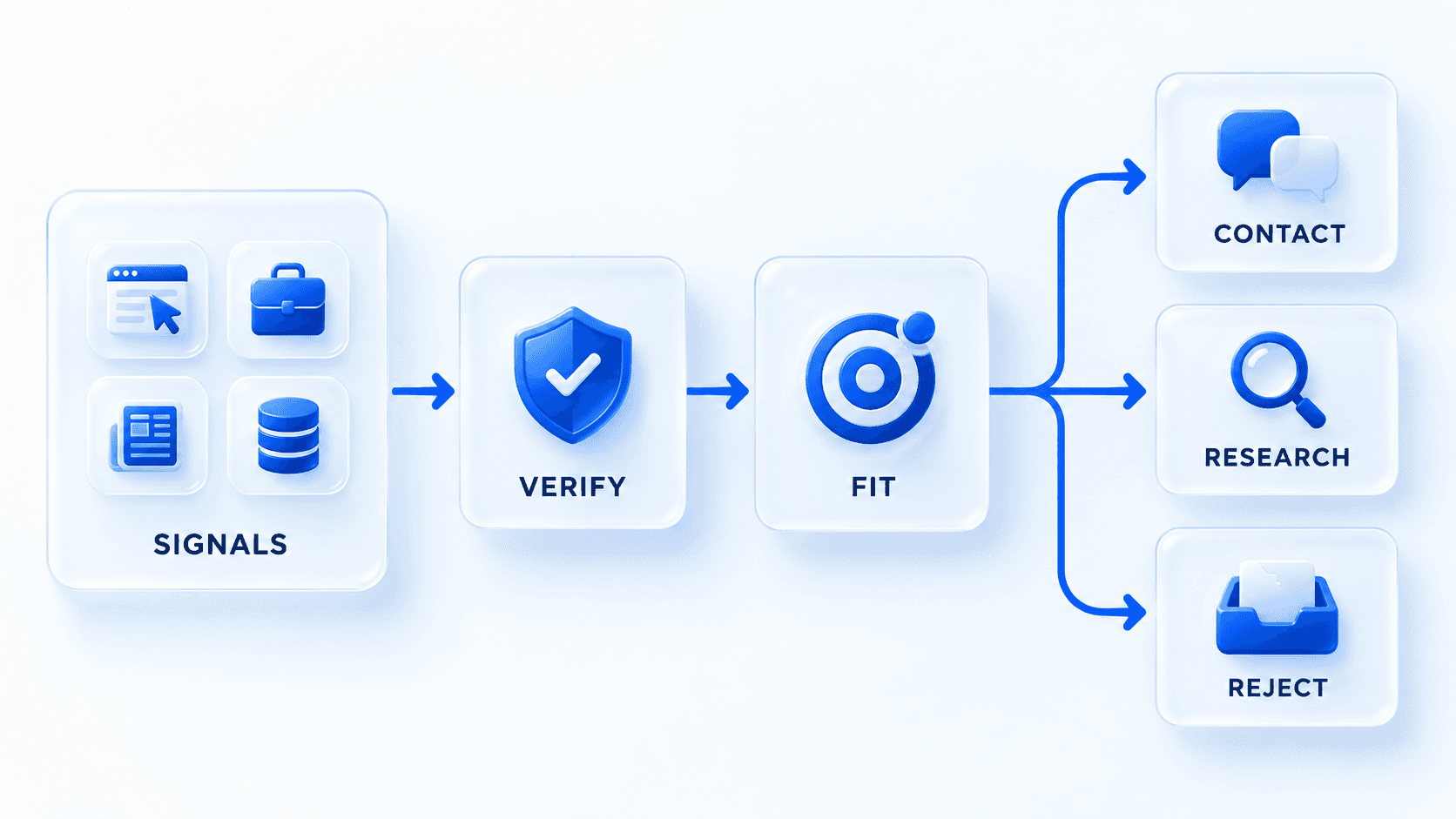
Signal types to use in a signal-based selling program
Useful signal types come from different data sources and answer different questions. Some show a company change. Others show behavior from a target account or contact. None should be treated as automatic readiness to buy.
First-party behavior and intent data
First-party behavior includes actions on channels you control, such as a known contact who downloads a guide, returns to a product page or asks a direct question. A contact may visit your pricing page while comparing options, researching for a colleague or checking a fact. The website visit is an observation. It becomes useful intent data only when you can identify the account, confirm the timing and connect the activity to a relevant sales motion.
Third-party intent signals can show that an account is researching a topic away from your site. Use them as a reason to examine the account, not as proof that a buyer has selected a vendor. Check how the provider collects the data, how quickly it arrives and whether the topic is specific enough for your offer.
Company and person changes
Hiring, funding, expansion, leadership changes, new regulations and product launches can affect priorities. A job change can also revive a relationship when a former customer moves to a target account. Verify the original announcement and ask what operational change could follow. A funding story alone says nothing about budget ownership or purchase timing.
Tech stack and operational changes
A new technology, migration notice, integration page or public job requirement can reveal part of a company’s tech stack. The useful question is whether that change creates a workflow your product can improve. Technology data can be stale, so confirm it before a sales rep refers to it.
How to build the program around your GTM teams
A signal based selling program needs shared rules across marketing, sales and RevOps. The following setup turns signals into a controlled queue for research and personalized outreach.
Define the target account and offer. Write down the firmographic fit, responsible roles and problems you can credibly discuss. Signal detection cannot repair weak targeting.
Choose a small set of data sources. Start with sources your team can verify, such as first-party activity, official announcements, current job listings and documented tech changes. Add real time buying signals only when their source and timestamp are clear.
Set an evidence threshold. Require a source, date, observed fact, offer connection and named owner before contact. Send incomplete records to research instead of outreach.
Connect the tech stack. Pass the verified record into the CRM with its source and routing decision. Avoid copying a vague intent score between tools without the evidence that produced it.
Give every route an owner and time limit. The research queue needs a due date. The contact queue needs a sales rep. Rejected records need a reason code that the team reviews.
Measure the full funnel. Compare qualification, meetings and pipeline by signal type. Reply rate and conversion rate can help diagnose the sales motion, but neither shows that signals close deals on their own.
Run the program with one or two signal types first. Review false positives, missing evidence and buyer corrections each week. Expand only after the team can explain why a record was contacted, researched or rejected.
1. Separate the event from the inference
Most weak signal workflows collapse three different statements into one:
Observed event: what the source actually says.
Hypothesis: why that fact may be relevant to your offer.
Missing evidence: what you still need to learn.
Suppose a target company announces a launch in two new countries. The announcement supports the claim that the company is expanding. It does not prove that the company needs new onboarding software, has a budget, is replacing an existing system or wants a sales call.
A defensible record might say:
Observed: the company announced a launch in Germany and France on 2 September. Hypothesis: a regional rollout may create new customer onboarding and localization work. Missing: the current onboarding process, the team responsible and whether the rollout has created a problem our product can solve.
That wording keeps research honest. It also gives the next researcher a clear job.
2. Verify the source and date
Treat the original source as part of the signal, not as an optional citation added later.
For every record, capture:
the original URL;
the publisher or account owner;
the publication or event date;
the date you checked it;
the company and person involved;
a short extract or factual summary;
any conflict with another reliable source.
A first-party announcement, regulatory filing, official job listing or current product page usually gives you a clearer factual basis than an undated repost. A second source can strengthen the context, but several pages repeating the same press release do not become independent confirmation.
Freshness is contextual. A leadership change may remain useful for weeks while the person settles into the role. A short-lived website action may lose meaning quickly.
Avoid a universal expiry rule. Define the useful window for each source type, then test it against your own results.
Our sales prospect research checklist covers the wider account, contact and evidence review.
3. Test relevance to your offer
A signal is useful only when it connects an observed change to a problem you can credibly discuss.
Ask four questions:
Does the account fit the customers we can serve?
Could the observed event change a workflow, priority, cost or risk related to our offer?
Is there evidence for that connection, or only a plausible story?
Can we ask a useful question without pretending to know the buyer’s internal situation?
This step prevents two common mistakes. The first is contacting every account that has done something newsworthy. The second is forcing a generic pitch onto a real event by inventing a pain point.
If the connection is weak, research further or reject the record. A smaller, well-supported queue is more useful than a large list of impressive-sounding events.
4. Route every record: contact, research or reject
Give each record one route and a named owner.
Contact
Choose contact when the event is current and verified, the account and contact fit, the offer has a credible relationship to the change, and the message can use a supported fact without inventing intent.
Research further
Choose research further when the event may matter but the source, date, responsible person or offer connection is incomplete. State the missing evidence and the next place to look. “More research” is not an action unless somebody knows what to verify.
Reject
Choose reject when the event is stale, unverified, unrelated to the offer, attached to the wrong account, or contradicted by stronger evidence. Record a reason code so the same weak pattern does not keep returning to the queue.
Useful rejection reasons include:
source missing;
date missing or outside the useful window;
account outside the target profile;
contact does not own the relevant workflow;
event unrelated to the offer;
duplicate record;
unsupported inference.
Fictional decision worksheet
The example below is explicitly fictional. The seller offers onboarding workflow software to B2B software companies.
Record | Source and date | Observed fact | Hypothesis | Missing evidence | Route | Owner and next action |
|---|---|---|---|---|---|---|
A — Northstar Cloud | Fictional first-party launch post, 2 Sep 2026; current job listings checked 3 Sep | The company launched in Germany and France and lists two local onboarding implementation roles. | Regional growth may create more onboarding handoffs, localization steps or process variation. | Who owns onboarding, what system is used now and whether the rollout has created a measurable workflow problem. | Research further | Maya: identify the onboarding leader and review current implementation material before deciding whether to contact. |
B — BlueOrbit | Fictional social repost, no original source or event date | A repost says the company is “expanding across Europe.” | Expansion could affect onboarding, but the statement is not yet reliable. | Original announcement, date, countries involved and evidence that the activity is current. | Research further | Sam: locate the first-party source. Reject if it cannot be verified. |
C — HarborStack | Fictional official award page, 1 Sep 2026 | The company won an office design award. | No credible connection to customer onboarding workflow software. | None that would make this event relevant. | Reject | Priya: close as “event unrelated to offer” and exclude this signal type from the current play. |
Notice that the strongest-looking record does not go straight to outreach. Record A has current first-party evidence and a plausible connection, but the team still needs to identify the owner and verify the workflow. Record C is true and current, yet irrelevant. Accuracy alone does not create sales relevance.
Copyable blank worksheet
Copy this table into your CRM, spreadsheet or research queue.
Field | What to record |
|---|---|
Account | Company name and CRM identifier |
Contact | Person, role and reason they may own the workflow |
Source URL | Original source rather than a repost where possible |
Source type | First-party announcement, job listing, filing, product page, engagement event or other |
Event date | When the event occurred or was published |
Checked date | When a researcher last verified the page |
Observed fact | One factual sentence supported by the source |
Hypothesis | How the event could relate to the offer |
Missing evidence | The facts needed before acting |
Route | Contact, research further or reject |
Owner | Person responsible for the next action |
Next action and due date | One concrete step |
Outcome | Qualified reply, neutral reply, rejection reason, meeting or no response |
5. Turn evidence into a relevant message
The first message should not claim that the prospect is “in market” simply because a signal exists. Use the fact you can support, explain the connection briefly and ask a question the recipient can answer.
For fictional Record A, a message could begin:
I saw Northstar Cloud’s announcement about launching in Germany and France, alongside the two local implementation roles. When regional teams start onboarding customers in parallel, how are you keeping the handoffs and localization steps consistent?
The first sentence identifies the evidence. The second frames a possible operational question without claiming the company has a problem. If later research shows that the contact does not own onboarding, do not send it to them.
Our guide to turning evidence into a relevant cold email provides more examples and a writing process.
6. Handle replies without losing the evidence
A reply changes the status of the record. It should also update your understanding of the signal.
If the prospect confirms the workflow and wants to explore it, pass the source, observed fact, hypothesis and their reply to the human owner.
If the prospect corrects your assumption, record the correction and revise the play.
If the recipient is not the owner, capture any suggested role or person without treating it as permission to contact them automatically.
If the prospect asks not to be contacted, stop the sequence and record the outcome.
If there is no response, do not manufacture a stronger claim in the follow-up. Recheck whether the event is still relevant and whether you have useful new information.
The handoff should preserve what was known, what was inferred and what the buyer actually said. That separation helps the next person continue the conversation without repeating research or overstating interest.
7. Measure the workflow by signal type
Count activity, but judge the play by useful outcomes.
Track at least:
records detected;
records rejected before outreach;
records sent to further research;
accounts and contacts reached;
replies that materially answer the question;
qualified replies;
confirmed meetings;
attended meetings;
opportunities and pipeline under a documented attribution rule;
rejection and correction reasons.
Compare cohorts by signal type, source, age and route. If one source creates many records but most are rejected for missing dates, fix or remove that source. If a signal produces replies but no qualified meetings, review the offer connection and targeting rather than celebrating reply volume.
The cold email metrics guide explains how to separate delivery and engagement measures from pipeline outcomes.
A weekly review that improves the play
Run a short review with sales and RevOps:
Which signals produced qualified conversations?
Which sources produced stale or unverifiable records?
Which hypotheses did prospects confirm or correct?
Which rejection reasons appeared most often?
Which rule should change before the next batch?
Update the routing rules, not only the score. A signal model improves when the team learns which evidence deserves action and which patterns create noise.
How Rhycon fits the workflow
Rhycon brings prospect discovery, contact enrichment, evidence-backed company research, personalized outreach, reply handling and meeting coordination into one workflow. It is designed to help teams move from targeting and sourced research to a relevant conversation without splitting the process across disconnected tools. For the wider path through outreach, replies and handoff, see our outbound sales automation guide.
See how Rhycon works and complete the interactive onboarding on the Rhycon homepage. You can also copy the worksheet above and use the downloadable scorecard below as supporting resources for your next batch of possible signals.