

A B2B buying signal is an observation that may give a sales team a reason to investigate an account. It is not confirmation that the company has budget, wants your product or is ready to buy.
That distinction matters when a signal becomes the opening line of an outbound email. A funding announcement may be accurate while the assumption built on it is wrong. A new executive may have a new title without any intention of replacing their software.
For a SaaS sales team, the useful question is: What does this evidence tell us about the specific problem our product solves?
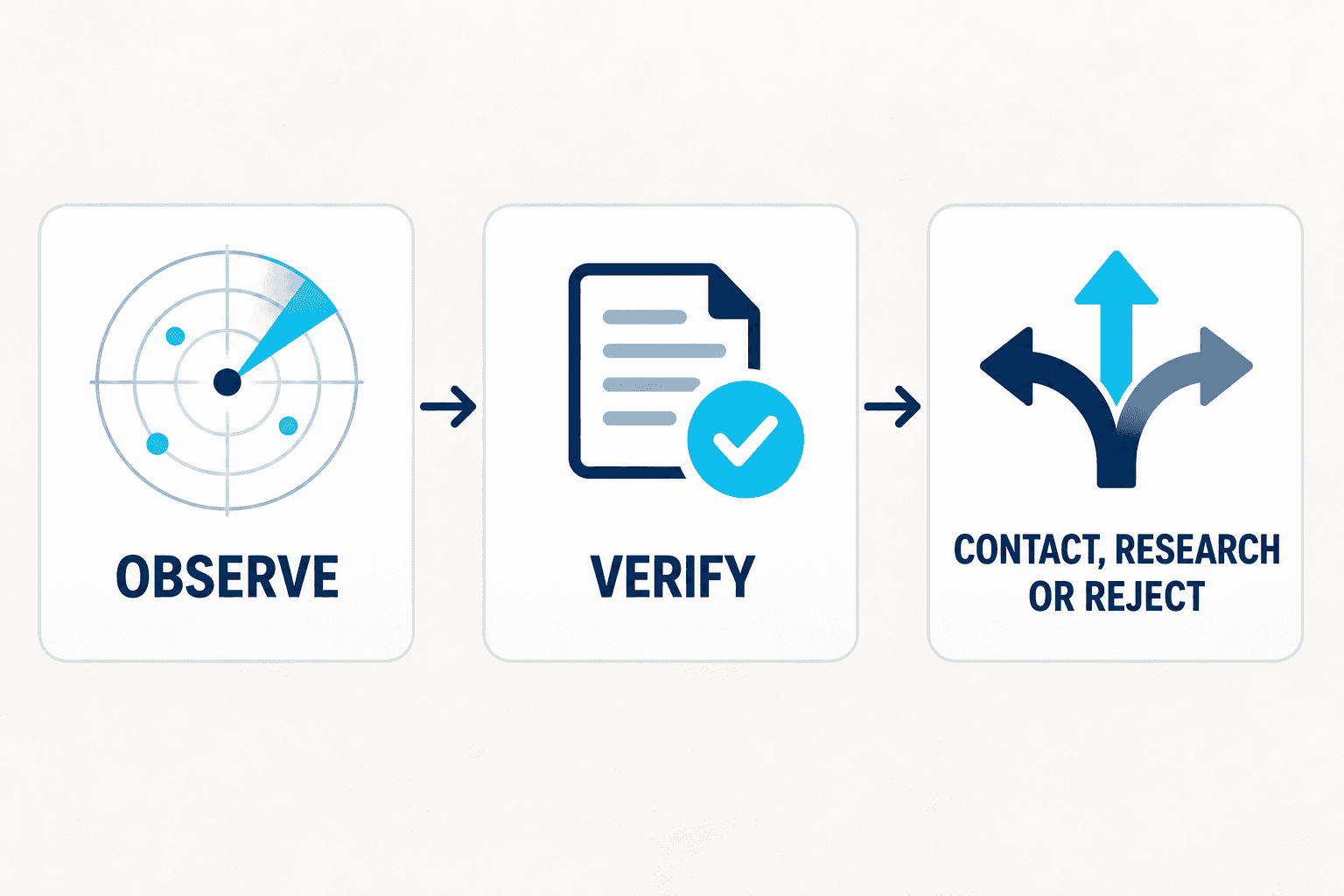
A quick B2B buying-signal checklist
Before using a signal in outreach, work through four questions:
Event: What changed at this company, and when did it happen?
Evidence: Which original source confirms the change and the company involved?
Relevance: How does the event connect to a workflow your offer supports?
Action: Is there enough evidence to contact the account, is another check needed, or should you reject the signal?
For example, a funding announcement is an event. A stated plan to build a new sales team supplies context. A connection to your product still needs to be established. None of those facts alone proves buying intent.
Start with the problem your product solves
Before collecting events, write down the operational change that makes your offer useful.
Suppose you sell software that helps revenue teams reconcile account ownership across territories. “Growing companies” is a broad audience description. “Teams reorganising ownership across regions while several systems hold different account records” is a situation worth investigating.
That situation gives the researcher a job. They need evidence of a relevant operating change, the people responsible and the systems involved. An unrelated award or generic hiring announcement adds little.
Make this definition narrow enough to reject accounts. Otherwise, almost any company news can be turned into a reason to send another message.
Separate the event from its interpretation
Use three fields when reviewing a candidate signal:
Observation
What belongs here: What a source actually says
What does not: An assumed business problem
Interpretation
What belongs here: Why the event might matter to this offer
What does not: A statement presented as proven customer need
Unknown
What belongs here: What still needs checking
What does not: A blank space silently filled with a guess
Here is a fictional example:
Observation: A SaaS company announces that two regional sales teams will move to one account-ownership model.
Interpretation: This may be relevant to a product that reconciles account assignments.
Unknown: Whether the company has already solved the reconciliation problem.
That record supports a sensible research question. It does not justify telling the company that its CRM is broken.
Evaluate common signals in context
New sales or RevOps leader
Potentially useful connection: Publicly stated priorities relate to your workflow
Reason to hold back: You only know their job title
Entry into a new market
Potentially useful connection: The expansion creates a relevant operational requirement
Reason to hold back: Your product cannot support that market
Hiring for a specific project
Potentially useful connection: The role description names a task your product supports
Reason to hold back: A vacancy alone does not show demand for software
Funding
Potentially useful connection: The company states a relevant use for the investment
Reason to hold back: You are assuming all funded companies want your category
A new product or pricing model
Potentially useful connection: It changes a process your offer addresses
Reason to hold back: The announcement concerns an unrelated part of the business
A technology change
Potentially useful connection: Verified transition affects a workflow you support
Reason to hold back: An old third-party listing is the only evidence
These are editorial examples, not a measured ranking of signal types. Their value depends on your offer and the account’s circumstances.
Check identity, source and timing
A relevant event attributed to the wrong company is unusable. Match the company’s name, domain, product and market before carrying the observation into outreach.
Then open the source. A search snippet or generated summary is a starting point, not enough to establish the full claim. Record the original URL, what it supports and when you checked it.
Distinguish the publication date from the event date. An article published this month may discuss an acquisition from last year. If the event date is unknown, preserve that uncertainty rather than describing it as recent.
Freshness should follow the decision. A temporary vacancy can become stale quickly; a phased regional rollout may remain relevant longer. Set review rules for the type of event rather than using one expiry window for every signal.
Match buying signals to the buying process
B2B buying signals become useful when they help you decide what to research next. A single website visit, job change or funding announcement does not prove purchase intent. Treat each observation as one of several data points and ask where it could fit in the buying process.
Stage | Possible signal | What to verify | Sensible action |
|---|---|---|---|
Problem awareness | Target accounts publish a plan that names a relevant operational change | The plan is current and your product or service supports that workflow | Research the responsible role and source |
Category research | Consent-aware first-party analytics show repeated visits to relevant educational or product pages | The activity can be connected to a known account under your privacy rules | Combine it with account fit; do not identify a person from anonymous traffic |
Evaluation | A buyer requests case studies, security information, integration details or a comparison | The request came from a real contact and names an active requirement | Route it to the right owner and answer the request |
Decision | Decision makers ask about implementation, commercial terms or a start date | The question refers to a real project and the stakeholders are clear | Treat it as a high intent signal and manage the agreed process directly |
The later rows can indicate more readiness to buy, but context still controls the decision. Someone can visit pricing or product pages for research, while an existing customer may ask an implementation question unrelated to a new purchase. Strong buying signals combine fit, credible evidence and a clear link to the offer.
Digital signals and verbal cues need different handling
Digital signals include first-party form submissions, known-account product-page activity, webinar registration and engagement with requested material. Sales and marketing teams should agree which events can be used, how consent and identity are handled, and when activity expires.
Company signals include leadership changes, hiring plans, launches, market expansion and technology transitions. These can help prioritize target accounts because they are tied to an organization, but they still need an offer-specific interpretation.
Verbal cues appear in a real sales call or reply. A buyer may describe the current process, name a deadline, ask who needs to approve the project or explain why the status quo is costly. Record the buyer’s own words separately from the seller’s interpretation.
Potential customers often produce mixed evidence. A company announcement may suggest fit while a contact says the project has no priority. Pay attention to the direct statement. Do not let a weak digital event override current human evidence.
Score a signal before it enters the sales process
A lightweight score can make review consistent without pretending to predict the purchasing decision. Give each field 0, 1 or 2 points:
Account fit: Does the company match the audience your product or service can support?
Evidence quality: Is there an original source or a direct buyer statement?
Relevance: Does the event connect to a specific workflow rather than a generic business change?
Recency: Is the event still useful for the expected sales cycle?
Role clarity: Is the person connected to the problem or the buying process?
For an initial test, a high score can trigger human review, a middle score can trigger more research and a low score can be rejected. These are starting thresholds, not universal conversion rules. Compare the same definitions across a stated period before changing them.
Case studies can strengthen an outreach message only when they are real, relevant and approved for use. They do not rescue a weak signal. Likewise, repeated website visits may justify account research, but they should not become a claim that an individual is “ready to buy.”
What to do when signals disagree
When evidence conflicts, preserve both facts and lower your confidence. A new executive may announce a transformation while the responsible manager says the project is paused. A known account may view several product pages while failing the basic fit criteria. In both cases, the safer decision is research or reject rather than an aggressive sales sequence.
Review the signal at each meaningful handoff. Sales and marketing teams should share the source, interpretation, remaining unknowns and next action. That keeps the signal useful after it leaves the original research queue and prevents an old assumption from following the account through the entire sales process.
Common questions about B2B buying signals
What is the strongest buying signal?
An explicit, current statement from a qualified buyer is usually more useful than inferred activity. A request for a proposal, an implementation question or a confirmed review date can show active evaluation. It still needs account fit, a clear owner and the buyer’s actual words recorded.
How many signals should you require?
There is no universal number. One direct request may justify a response, while several weak third-party observations may justify only research. Define the evidence needed for each action, measure the outcomes and revise the rule when it produces false positives.
Are website visits enough to contact someone?
Anonymous visits do not identify an individual buyer. Known-account activity can help prioritize research when collected and used under your privacy rules, but it should be combined with fit and relevant evidence. Never tell a person you tracked activity that your system cannot reliably attribute to them.
When should a signal expire?
Set the review window around the event. A webinar registration may lose relevance quickly; a documented multi-quarter rollout may stay useful longer. Record the event date, date checked and next review date so old evidence does not re-enter outreach as if it were new.
Make one of three decisions
Contact: The account fits, the source is credible and the connection to your offer is specific enough to explain. Your message can refer to the observation without asserting unknown pain.
Research: The account looks relevant, but an important link is missing. Check the missing fact before adding the prospect to a sequence.
Reject: The company is wrong, the evidence is stale, the problem is unrelated or the connection depends on several assumptions.
Rejecting weak signals is useful work. It keeps research notes from becoming a collection of excuses to contact everyone.
Use the signal-based selling workflow to put those decisions into practice. Its worked records and blank worksheet show how to assign a next action while keeping evidence, interpretation and unknowns separate.
A review record can be simple:
Account and domain:
Source URL and date checked:
Event and event date:
Relevant workflow:
Responsible role:
Known facts:
Remaining unknowns:
Decision and reason:
The prospect research checklist develops this into a fuller account brief.
Turn the signal into an honest opening
Consider this fictional message fragment:
Your announcement says the regional teams are moving to one ownership model. We help RevOps teams reconcile account assignments during that kind of change. Is that work already covered?
It names the evidence, explains the offer and leaves room for the answer to be “yes.”
Compare it with “Your expansion must be creating CRM chaos.” The latter substitutes an accusation for research.
See the personalised email examples for more ways to connect evidence to a message without inventing the recipient’s situation.
Measure the decisions as well as the replies
Store the signal type and review decision alongside the account. When outcomes arrive, inspect which observations led to relevant conversations and which produced rejection or confusion.
A reply is not automatically a qualified opportunity. Track the progression with explicit definitions, as described in the outreach measurement guide.
Keep enough rejected examples to improve the process. If a signal repeatedly produces incorrect assumptions, change the rule or stop using it.
To put this process into practice, see how Rhycon works and complete the interactive onboarding. It connects prospect research, buying signals, personalised outreach and reply handling.