

An SDR-to-AE handoff is the point where responsibility for a qualified pre-sales conversation moves from sales development to an account executive. A useful handoff transfers the evidence, the buyer’s exact words, the questions that remain and the next step already agreed.
A calendar booking alone is not the handoff. Neither is a high score, a copied transcript or a message in a team channel. The receiving AE needs enough context to continue the buyer’s conversation without starting the research again or inventing certainty that the SDR did not have.
This guide gives you a readiness decision, a minimum context packet, accepted and returned fictional examples, and a copyable handoff note.
Keep the scope clear: this is a pre-sales handoff
“Sales handoff” can also describe the move from a closed deal to customer success or implementation. That is a different workflow with different information, owners and risks.
The SDR-to-AE handoff happens earlier. It connects prospecting, qualification and the first meaningful buyer interaction to discovery and opportunity work. Its purpose is to let the AE understand:
why this account and contact were selected;
which facts support the outreach;
what the buyer actually said or asked;
which qualification questions are answered or still unknown;
what has already been promised;
who owns the next action.
Apollo describes an AI-SDR-to-AE handoff as a structured escalation with context rather than a meeting booking alone. Its conversation documentation also shows how summaries, outcomes, next steps, objections and source conversations can be made available to teammates. The tool can vary; the transferable principle is that the record must preserve the conversation.
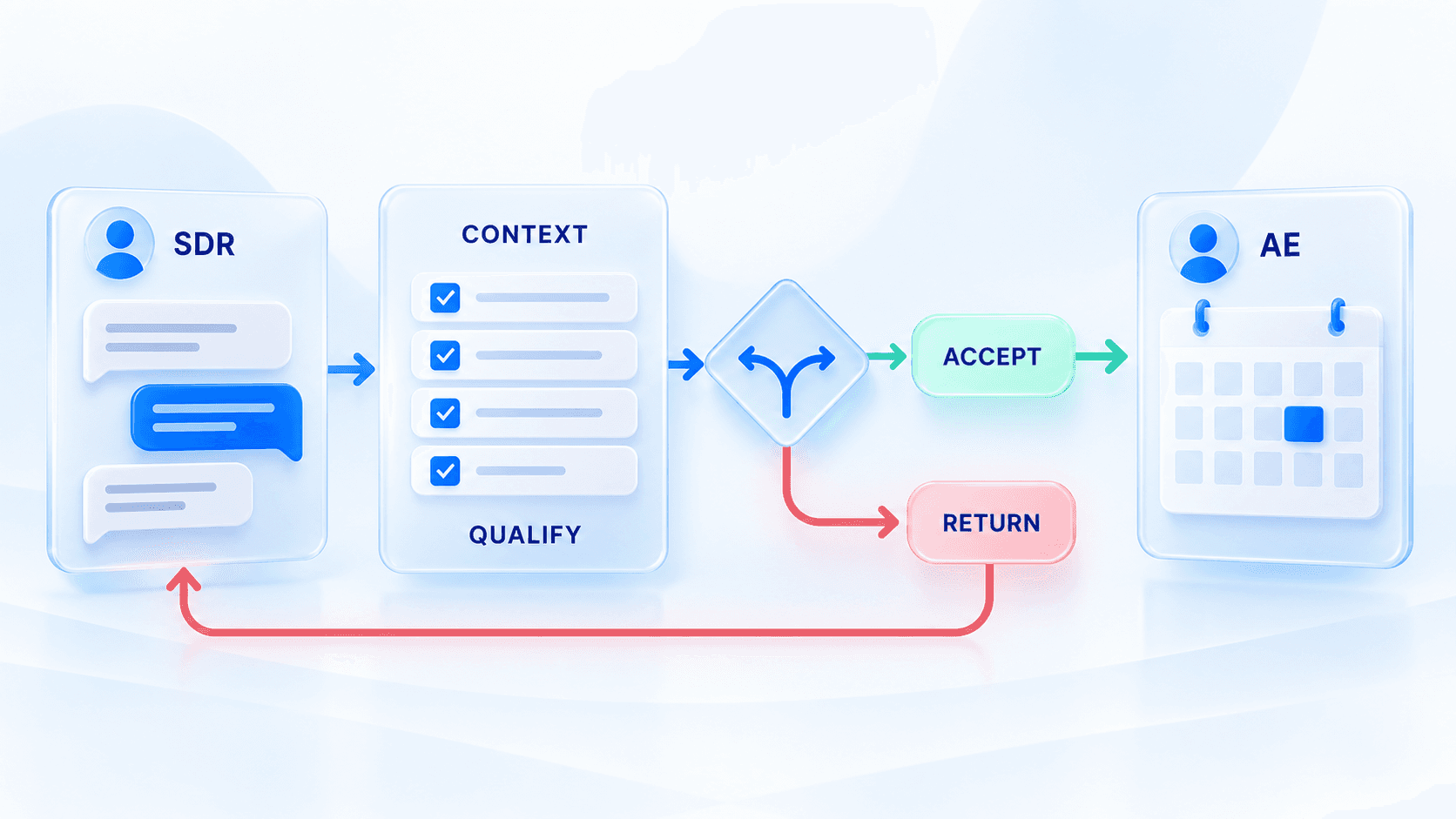
Agree the readiness decision before leads arrive
Write down the conditions for three routes: accept, return for research and close or reject. If the standard exists only in one manager’s judgment, the SDR cannot prepare a consistent packet and the AE cannot explain why a record was returned.
Accept the handoff when
the account and contact fit the current targeting rule;
the source evidence and dates are recorded;
a substantive buyer reply, call or requested next step exists;
the exact buyer wording is available;
known facts and working hypotheses are separated;
important unknowns are labelled;
the AE or receiving queue is identified;
the next action and any commitment already made are clear.
Acceptance does not require every qualification field to be known. A buyer may agree to discovery before discussing budget, procurement or timing. An unknown budget means the field is unanswered. It does not mean the budget is zero, and it does not prove the opportunity is qualified.
Our guide to lead qualification and lead scoring explains this separation. A score can help a team prioritise review, while qualification records what the evidence currently supports.
Return for research when
the reply or conversation cannot be found;
a summary makes claims that the source does not support;
the contact’s role or account identity is unresolved;
the record says “interested” but provides no buyer words or event;
the promised next step, participants or timing are unclear;
a material source is stale, inaccessible or missing;
the owner could correct the gap without contacting the buyer again.
Returning a record should create a specific correction task. “More context needed” is too vague. “Attach the buyer’s reply and identify the question they want answered” tells the SDR what evidence will change the decision.
Close or reject when
the person opted out or said the topic is not relevant;
the account or contact is outside the agreed scope;
the address is invalid and no verified correction exists;
the original signal has expired;
the record duplicates an active conversation;
the proposed next action would conflict with a suppression or ownership rule.
The minimum context packet
A long note is not automatically a complete note. The minimum packet should be compact enough to review and specific enough to audit.
Field | What to record |
|---|---|
Account and contact | Current company, person, role and verified contact channel |
Source and date | Original URL or conversation reference, event date and date checked |
Observed fact | What the source or buyer actually said, without interpretation |
Fit and hypothesis | Why the evidence may connect to the offer; label inference clearly |
Outreach history | Relevant messages or calls, including who sent them and when |
Exact buyer reply | Verbatim buyer words needed for the next conversation, within your access rules |
Questions and objections | Topics the buyer raised and anything already answered |
Qualification | Known answers, unknown fields and evidence for each conclusion |
Commitment made | Material, answer, introduction or meeting the SDR promised |
Meeting status | Proposed, booked, confirmed or attended; include participants and time where known |
Receiving owner | Named AE or defined queue responsible for accepting the record |
Next action | One owner, one action and the agreed or planned time |
Return reason | If not accepted, the exact evidence or correction required |
The sales prospect research checklist can supply the account, contact and source fields. The handoff note should reference that evidence rather than replacing it with a vague summary.
Fictional accepted handoff
The company, people and conversation below are entirely fictional. They are included to demonstrate the decision, not to imply a customer result.
Record
Field | Fictional entry |
|---|---|
Account and contact | Harborline Systems; Priya Shah, VP Revenue Operations |
Source and date | Harborline careers page and official expansion announcement; checked 8 Sep 2026 |
Observed fact | The company is hiring sales roles in two regions and announced a second-market launch |
Working hypothesis | A larger distributed team may need a more consistent research-to-reply handoff; not yet confirmed |
Outreach history | Two-message thread about preserving prospect context during regional growth |
Exact buyer reply | “We are reviewing how SDR notes reach the regional AEs. Send the five-field example and we can discuss it on Thursday.” |
Buyer question | What does the five-field handoff look like in practice? |
Qualification known | Role and workflow topic are relevant; the buyer requested an example and discussion |
Qualification unknown | Budget, buying process, security requirements, implementation timing and other stakeholders |
Commitment made | Send the example before the Thursday conversation |
Meeting status | Time proposed by buyer; calendar confirmation still required |
Receiving owner | Morgan Lee, fictional account executive |
Next action | Morgan sends the example and confirms the Thursday time |
Decision: accept
The handoff is ready because the packet identifies the account and owner, preserves the research, includes the exact buyer request, distinguishes known and unknown qualification, and names the next action. Budget remains unknown. That uncertainty belongs in discovery rather than being changed to zero or silently marked complete.
The AE should continue from the buyer’s question. A generic product introduction would discard the context the handoff was meant to protect.
Fictional returned handoff
This example is also entirely fictional.
Submitted record
Field | Fictional entry |
|---|---|
Account | Stonebridge Analytics |
Contact | “Marketing lead” |
Trigger | “Clicked and seems interested” |
Reply | Not attached |
Meeting | “Maybe next week” |
Owner | Unassigned |
Decision: return for research
The record does not identify a current person or role, the word “interested” has no buyer statement behind it, a click is being treated as qualification, and neither the meeting nor owner is defined.
Return reason: attach the relevant message or call, verify the contact and role, record the buyer’s exact words, and identify whether a meeting was requested, proposed or confirmed.
Corrected record
The SDR finds that the activity was a resource click with no reply. The named contact left the company two months earlier. The correction changes the route from handoff to research: verify whether a current, relevant contact exists and reassess the reason to contact. Do not pass the account to an AE as an interested buyer.
This is useful feedback. It reveals that the process was equating activity with intent and that contact freshness needs to be checked earlier.
Copyable SDR-to-AE handoff note
Use this as a starting template in your CRM, sales workspace or shared record.
Handoff field | Entry |
|---|---|
Account | |
Contact and current role | |
Contact verification date | |
Original research source | |
Source/event date | |
Observed fact | |
Working hypothesis | |
Outreach or call history | |
Exact buyer reply | |
Buyer question | |
Objections or constraints | |
Qualification known | |
Qualification unknown | |
Commitment already made | |
Meeting status and participants | |
Receiving AE or queue | |
Next action | |
Next-action owner | |
Agreed or planned time | |
Return reason, if applicable | |
Correction completed |
Attach or link the source conversation where the recipient has appropriate access. A summary helps someone scan; it should not prevent them from checking the buyer’s exact words when nuance matters.
Confirm receipt and ownership
Submission is not acceptance. Define a small state model so the record cannot sit between teams without an owner:
Prepared: the SDR believes the packet meets the standard.
Submitted: the receiving AE or queue can review it.
Accepted: the AE owns the next action.
Returned: the SDR owns a named correction.
Closed or rejected: the reason is recorded and no action remains.
The process does not need an invented response-time promise. It needs visible ownership. If your team later introduces a service level, base it on capacity, buyer expectations and measured outcomes, then document exceptions such as out-of-office coverage.
For an automated or AI-assisted workflow, test whether the system preserves evidence and routes uncertain cases correctly. The AI sales agent evaluation guide includes human-handoff and control checks that can be adapted to this boundary.
How to implement the SDR-to-AE handoff workflow
Sales teams get better results when SDRs and AEs define the handoff together. The SDR team should know what evidence to collect, while the account executive (AE) should know when to accept a qualified lead and when to return it for a specific correction. That shared rule turns the AE handoff process into a visible part of the sales process.
1. Agree the qualification criteria
Start with the minimum qualification criteria for your offer. Include fit, the buyer’s stated pain points, the reason for the conversation and the next step. Company size may matter for one offer and be irrelevant for another. Keep qualifying questions short enough for a natural conversation, and leave honest unknowns for the discovery call.
A sales development rep should never fill an empty field with a guess. The goal is to pass qualified leads with the evidence available, not to pretend every part of the buying process is known before discovery.
2. Make the required CRM fields unavoidable
Put the required CRM fields in the handoff record: source, date, buyer words, qualification known, qualification unknown, meeting status, receiving owner and next action. Link to the original conversation whenever access rules allow. When AEs receive the record, they should be able to scan it and then inspect the evidence without rebuilding the research.
3. Define ownership and response states
Use the prepared, submitted, accepted, returned and closed states above. If you introduce AE response times or service level agreements, base them on actual capacity and buyer expectations. Record exceptions and backup ownership so a handoff does not disappear when someone is unavailable.
SDR-to-AE handoff SLA: a simple example
Agree three rules before a buyer meeting is booked: the submitted record names the receiving AE or backup owner; that owner accepts or returns it before the next buyer commitment; and a returned record names the missing evidence, the correction owner and the next review point. Set the response window from your team’s actual capacity. Track overdue commitments as well as acceptance time, because a quick acceptance with missing context is still a weak handoff.
4. Review the process with both teams
Review return reasons, meeting attendance, opportunities and conversion rates by handoff route. A high acceptance rate with weak downstream outcomes may point to loose qualification. Frequent returns may show that a field, source link or ownership rule is unclear. Use those findings to improve the workflow across the full sales cycle.
Measure handoff quality through outcomes
Count the states separately so meeting volume does not hide context loss.
Track at least:
prepared and submitted handoffs;
accepted handoffs;
returned handoffs by specific reason;
corrections completed;
meetings proposed;
meetings confirmed;
meetings attended;
opportunities created under a written definition;
pipeline and closed outcomes under a documented attribution rule;
records closed or rejected before AE work.
An acceptance rate measures whether the packet met the receiving standard. It does not prove that the opportunity will close. A booked meeting is a calendar event, while attendance and opportunity creation are later outcomes. The cold email metrics and pipeline guide shows how to keep those stages separate.
Review return reasons with both teams. If missing buyer words appear repeatedly, change the required field or integration. If handoffs are accepted but the AE must redo the research, inspect source access and note quality. If meetings are booked but rarely attended, investigate confirmation and targeting rather than declaring the handoff complete.
How Rhycon fits the workflow
Rhycon brings prospect discovery, contact enrichment, evidence-backed company research, personalised outreach, reply handling and meeting coordination into one workflow. That helps preserve the path from the original targeting decision to the qualified conversation.
Copy the handoff note above into the system you already use. Then see how Rhycon works and complete the interactive onboarding. Keep the acceptance decision and owner visible, whatever tool stores the record.